
Cherry Hill Previous Residents by Era
For Cherry Hill, the strongest starting source depends on the period. The county parcel record identifies the current site and its land key. Recorded land instruments can then document the title sequence. Historical directories, telephone books, and census schedules add household-level clues, while maps, newspapers, probate, cemetery, and vital material can explain a move or a final disappearance. None of these sources means exactly the same thing, so keep the type of proof beside every name.
| Source | Years It Covers | Where Held | What It Shows |
|---|---|---|---|
| Prince William deed and land index | 1918 to present | Eagle Recorder, clerk terminal, and historic HOP research | Grantor, grantee, recording reference, date, and legal description; not proof of a household |
| Recorded plats | 1918 to present online; earlier material may require local or archive research | Eagle, Circuit Court Clerk, Development Services, and Library of Virginia | Lot, block, subdivision, easement, and road-change context |
| Local and regional directories | Manassas 1960 to 1983; regional 1963 to 1980; county 2001 and 2007 to 2020 | RELIC shelves | Listed household or subscriber lead, with address and issue-specific detail |
| Telephone directories | Selected books from 1903 through 2009 | RELIC | Subscriber, phone, and address clue; gaps and omissions apply |
| Federal census | Individual schedules through 1950 | NARA, RELIC, library databases, and FamilySearch | Household details by enumeration context |
| Newspapers and obituaries | Local News Index since 1993, with some obituaries from 1970; older holdings vary | RELIC Digital Archives and library shelves | Dates, relatives, notices, and local connections; not complete |
Use a later deed or parcel record first when a Cherry Hill address is still standing. For an earlier family question, begin with the nearest dated directory or census and then test the location against the land trail. The order prevents an address clue from being mistaken for title evidence.
Fix a Cherry Hill Previous Address
At a Cherry Hill address, normalize the current address before moving back in time. Prince William PublicAccessNow Address Search uses house number, house-number high, and street name. Its instructions say to omit a compass direction and street suffix from the name field. The returned parcel can provide a GPIN, situs address, owner, mailing address, legal description, sale information, and land or building details. The owner mailing address is not proof that the owner lived at the parcel.
For Cherry Hill, copy the GPIN, lot or block language, subdivision name, and full legal description before changing search tools. A street name can change form across old books, postal systems, or mapping practices. The research found no Cherry Hill-specific renumbering year, so use legal descriptions, the 1992 historical map, adjacent landowners, plats, and GPIN history instead of inventing a street conversion.
Note: A GPIN links county map, assessment, and deed systems, but it identifies a parcel rather than every person connected with it.
Trace Cherry Hill Previous Residents Through Deeds
For a Cherry Hill parcel, the recorded title trail begins with the current parcel record and moves backward through the Prince William County Circuit Court Clerk's land records. In Virginia, the clerk serves the recorder role. Eagle Recorder's occasional-user route provides a free index search, while document images carry the stated online image and convenience charges. The in-person terminal avoids the online convenience charge and has a per-copy fee. Use the current owner's purchase date and legal description to narrow the first search.
- Find the current parcel in PublicAccessNow and copy the GPIN, situs address, legal description, current owner, and last sale date.
- Search the current owner as a grantee in Eagle near that purchase date, then open or request the purchase instrument.
- Record the seller, the recording date, the prior deed reference, and the legal description from that instrument.
- Search that seller as a grantee to locate the prior acquisition, then repeat the same comparison.
- When the description changes, check recorded plats and subdivision instruments before assuming the street address identifies the same land.
For Cherry Hill history, the Circuit Court's historical research guide describes HOP phases for wills and heirs, the deed index, and marriage licenses, and directs deeper work to the Historical Document Room, RELIC, Historic Prince William, and the Library of Virginia.
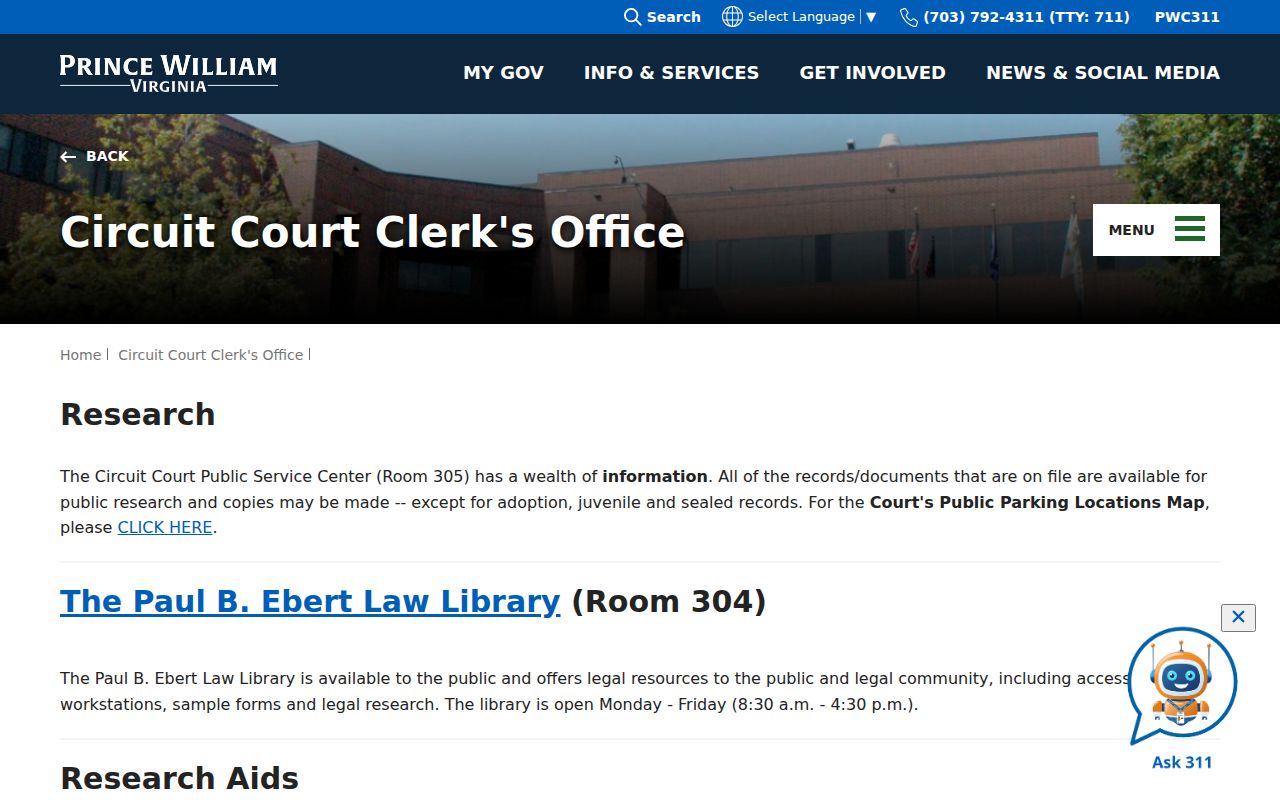
The guide supplies an access route for historical research; it does not promise that a complete chain or every document image is online.
- Grantor and grantee
- The grantor transfers an interest in recorded land, and the grantee receives it in that instrument.
- Chain of title
- The successive recorded transfers used to follow an interest in the same parcel backward through time.
- Legal description
- The lot, block, subdivision, metes-and-bounds, or plat wording that identifies land more reliably than an old street form.
Cherry Hill Past Residents After 1918
For Cherry Hill, January 1, 1918 is the practical online boundary for Prince William deeds, related land records, and plats in Eagle. The same system has different later cutoffs for other record types, including fiduciaries from 1981, fictitious names from July 1, 1986, judgments from 1988, and UCC records from 1989. Do not apply the land-record date to a probate or marriage search without checking the record set.
In Cherry Hill research, index searching is free. The county states that an online image costs $0.50 plus a $2 Internet Convenience Fee, while public terminals at the clerk's office have no logon or convenience charge and charge $0.50 per copy. Certified copies come from the clerk, because a historic online image is not necessarily the official record required by law.
Cherry Hill Past Residents Before 1918
Earlier Cherry Hill work changes from online lookup to reconstruction. Move from Eagle to the clerk's Historical Document Room and public terminals, HOP research access, RELIC, the Library of Virginia microfilm collection, and the FamilySearch catalog. A surviving book or abstract reference can still point to a record when an image is not displayed online. Ask each custodian about the specific type of record and date range rather than making a broad request for all past residents.
For Cherry Hill, the 1863 loss, destruction, or theft of many pre-Civil War Prince William records is a central local limitation. Substitute evidence can include surviving deed books or abstracts, tax material, wills and heirs, church and cemetery records, newspapers, and county microfilm. A gap may be real. Preserve the source trail and the uncertainty instead of inserting a presumed link between names.
Note: Prince William's 1863 records loss means a careful title or family trail may remain incomplete even after every documented archive route is used.
Cherry Hill Previous Residents in Directories
Cherry Hill recorded owners are only one part of a past-address story. RELIC's Manassas, Potomac-corridor, county, and telephone-book collections can supply a dated subscriber or head-of-household lead. Some issues have an address-ordered criss-cross section. That section can be useful when a surname search fails, but the collection is not fully digitized and the exact issue must be checked on site.
Copy the edition, page, address, abbreviation, and family detail exactly. A local listing may use Cherry Hill, Neabsco, Dumfries, Woodbridge, Occoquan, or a rural-route label. A directory address should not be equated with a deed's legal description. The collection years and entry-reading method are described in the Cherry Hill city directory resource.
Census Pairing for Cherry Hill Past Residents
Use the directory and census layers as a timed process. NARA reports that federal population censuses were taken every ten years, and individual schedules are public through 1950. Cherry Hill may be indexed under a district or neighboring village rather than its modern CDP name. A directory address can help find the right enumeration district, while the census can test whether the household composition fits the date.
- Choose a directory or telephone-book issue close to the period being researched.
- Record its address and all alternate place wording, then locate the matching census year or nearest public schedule.
- Compare the household details with the address, road, and adjacent families rather than matching on surname alone.
- Return to the next earlier directory or deed reference and repeat the date comparison.
- Use obituary, funeral-home, probate, cemetery, or marriage and death indexes when a household vanishes from the trail.
For a Cherry Hill trail, the 1890 population schedule was largely destroyed. Around that break, RELIC's newspapers, surviving microfilm, church and cemetery files, county tax material, and deed abstracts can be more informative than a search for a missing census page.
Cherry Hill Previous Residents in Maps and News
For Cherry Hill, maps and news records can supply the context that a deed omits. RELIC's Digital Archives includes the 1992 Historical Map of Prince William County, whose index lists roads, towns, plantations, runs, churches, and alternate names by grid or quadrant. RELIC also holds local-news indexing, obituaries, funeral-home material, historic-site files, photographs, and county record microfilm. These sources can explain a place name or later family connection, but they should be compared against the dated land or census record.
The Library of Congress Sanborn guide explains searches by state, city, edition date, and sheet. The research found Manassas editions for 1907 and 1912, but no Cherry Hill-specific Sanborn volume. Do not substitute a Manassas sheet for a Cherry Hill address simply because the place is nearby.

The map guide helps check whether a historic volume exists for the requested locality; a no-result is more useful than a misleading substitute map.
Lawful Cherry Hill Previous Residents Research
In Cherry Hill, use a backward address trail for personal house history, family history, heir research, civic curiosity, or verification of a recorded transaction. Public records have boundaries. A parcel does not list everyone at an address, a directory is not a complete household roster, and protected addresses or restricted court and vital material must not be reconstructed from partial clues.
Lawful use. Virginia's stalking and computer-harassment laws still apply to information that can be found in public records. Do not use a historical address trail to follow, contact, harass, or expose a living person.